
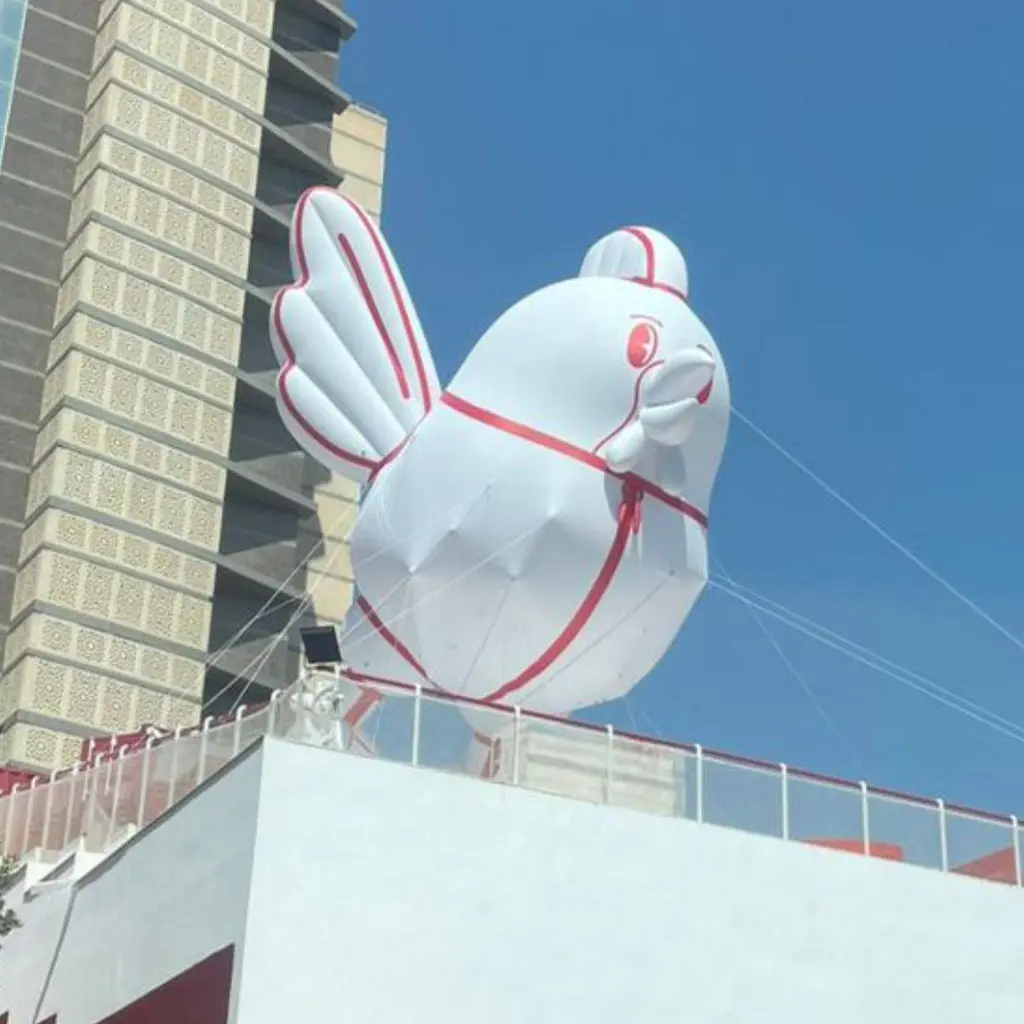
The short answer: Secure inflatable roof decorations with at least two independent anchoring points per tether — roof-safe ballast (sandbags or weighted bases), ratchet straps, and rated anchor loops — never rely on the flimsy ground stakes that ship with most consumer inflatables. Keep every power connection off the wet roof surface and behind a GFCI outlet, and take the decoration down when wind gusts reach 40 km/h (≈25 mph) or your manufacturer’s rated limit, whichever is lower.
Inflatables are the most visible part of holiday curb appeal — and the most likely thing to end up in your neighbor’s yard. As an inflatable manufacturer with 17 years of engineering and testing experience (we build custom decor at Inflart), here’s the exact method we recommend for keeping roof-mounted decorations where they belong.
Why Inflatable Decorations Come Loose on Roofs
A fully inflated decoration is essentially a large, lightweight sail. Put that sail on a roof — the most wind-exposed surface of your house — and the physics work against you in three ways:
- Sail effect. A 1.2 m (4 ft) inflatable presents roughly 1.5 m² of surface area to the wind. At 40 km/h, that translates to meaningful lift and drag forces pulling on every anchor point.
- Gust exposure. Roofs get hit by stronger, more turbulent gusts than ground level. The peak gust — not the average wind — is what pulls decorations loose.
- Wrong anchoring hardware. The plastic stakes included with most consumer inflatables are designed for soft lawn soil. On shingles, tile, or flat roofing membrane they have nothing to grip, so the decoration is effectively unanchored.
Safety regulators treat this seriously. SafeWork Australia’s guidance for inflatable devices requires devices to be “secured and anchored with anchor points provided according to the manufacturer’s instructions and relevant technical standards,” and evacuated when wind gusts exceed the manufacturer’s guidelines or 40 km/h — roughly 25 mph. The UK Health and Safety Executive makes the same point: always confirm the maximum safe wind speed from the manufacturer’s operating manual.
Rule of thumb: If gusts are forecast to hit 40 km/h (25 mph) or more, your roof inflatable comes down. Don’t wait to see if it survives.
What You Need Before You Start
Gather everything before you climb a ladder. A complete roof-anchoring kit looks like this:
| Item | Why you need it |
|---|---|
| Sandbags or weighted ballast (2–4 per decoration, 10–20 kg each) | Primary anchoring on roofs — no punctures, no damage |
| Ratchet straps or heavy-duty tie-downs (UV-resistant) | Connect the inflatable’s anchor loops to the ballast or roof anchor points |
| Paracord or tarp straps | Secondary tethering for extra wind resistance |
| Strap protectors or old towels | Prevent straps from rubbing and wearing roof shingles |
| GFCI extension cord + drip loop | Safe power routing — never a bare connection on a wet roof |
| Ladder + a helper | Roof work is a two-person job; never carry an inflated decoration up a ladder alone |
How to Secure an Inflatable on a Roof — Step by Step
Step 1: Choose the right spot
Place the decoration where it’s visible from the street but sheltered from the prevailing wind. Avoid roof peaks, ridge lines, and edges directly facing open fields or streets — these get the strongest gusts. If you have a choice, a spot just below the ridge on the leeward side will dramatically reduce wind load.
Step 2: Inspect the anchor points before inflating
Check every anchor loop, strap, and seam. Professional-grade inflatables ship with reinforced anchor points engineered for tie-downs — this is standard practice at Inflart, where every custom piece goes through precision manufacturing and testing before it ships. If your decoration has only one anchor loop per side, plan to use two independent tether lines from each loop, spread wide, to create a stable triangle.
Step 3: Inflate fully, then anchor
Let the blower run until the decoration is fully firm (usually 1–3 minutes). A half-inflated decoration flops and tears in the wind — it’s also harder to anchor accurately. Once fully inflated, seat it in position, then secure it.
Step 4: Anchor with ballast and straps — never ground stakes
On a roof, your anchor system is:
- Lay 2–4 sandbags (10–20 kg each) flat against the roof, positioned at the decoration’s base and upwind side.
- Run ratchet straps through the inflatable’s anchor loops, around or through the sandbags, and back — cinch them tight so the decoration can’t lift or slide.
- Spread the tether lines at 45° angles where possible. Two widely spread tethers resist wind far better than four lines all pointing the same way.
Never attach tethers to gutters, downspouts, or chimney flashing — you’ll bend the gutter and the decoration will pull free anyway. And never drive stakes, nails, or screws into your roof: puncturing shingles or roofing membrane invites leaks that cost far more than the decoration.
Step 5: Protect the roof surface
Pad every strap where it crosses a shingle or flashing with a strap protector or a folded towel. Wind makes straps vibrate and saw back and forth — without padding, that friction will wear away granules and shorten your roof’s life.
Step 6: Route power safely
- Plug into a GFCI-protected outlet (code-required for outdoor receptacles).
- Use a heavy-duty outdoor extension cord rated for the blower’s wattage.
- Never leave a connection lying on the roof or in pooled water. Create a “drip loop” — let the cord dip below the outlet before it rises to the decoration — so water runs off the cord instead of into the connection.
- Use a timer so the blower isn’t running 24/7 unattended.
Step 7: Monitor the weather and take down on time
Check the forecast daily. The moment gusts are forecast near 40 km/h (25 mph) — or your manufacturer’s lower rating — take the decoration down. Store it dry and deflated; a wet, frozen inflatable is heavy, brittle, and a hazard if it comes loose.
Anchoring Methods Compared
| Method | Best for | Wind resistance | Roof damage risk |
|---|---|---|---|
| Sandbags / weighted ballast + straps | Roofs (shingle, tile, flat) | 🟢 High | None (no punctures) |
| Ratchet straps to permanent roof anchors | Recurring seasonal display | 🟢 Very high | Low (installed once by a pro) |
| Ground stakes | Flat lawn only | 🔴 Low | N/A on roofs — useless on shingles |
| Gutter/downspout attachment | ❌ Don’t do this | 🔴 None | High — bends gutters, decoration pulls free |
| Water barrels / heavy bases | Flat roofs, large decorations | 🟡 Medium | Low (watch membrane abrasion) |
Roof Safety Rules — Never Skip These
- Two people, one ladder. One person hands up the decoration, the other anchors. Never climb with an inflated decoration in your arms.
- No roof work in wind, rain, or snow. Wet shingles and gusts are a fall risk before they’re a decoration risk.
- Never modify your roof. No stakes, screws, or nails. Use ballast or professionally installed anchor points.
- Check tethers daily. Retighten after every storm — UV and vibration loosen straps over time.
- Know your wind threshold. Manufacturer’s rating first, 40 km/h second — take the lower number.
Frequently Asked Questions
Can I stake an inflatable decoration directly into my roof?
No. Driving stakes, nails, or screws into shingles or roofing membrane punctures your waterproofing and can cause leaks. On a roof, use weighted ballast (sandbags) with straps through the decoration’s anchor loops, or professionally installed permanent anchor points.
How much wind can an inflatable decoration handle?
It depends on the manufacturer’s rating — check the operating manual, as the HSE advises. As a general safety threshold, SafeWork Australia requires inflatables to be evacuated when gusts exceed 40 km/h (≈25 mph). Treat 40 km/h as your absolute ceiling for roof decorations.
What’s the best way to anchor an inflatable on a flat roof?
Sandbags or weighted bases positioned at the base and upwind side, connected to the inflatable’s anchor loops with ratchet straps spread at 45° angles. On a flat roof, also protect the membrane by placing a mat or plywood under the sandbags.
Will an inflatable decoration damage my roof?
Not if anchored properly. Ballast creates no punctures, and padded straps prevent abrasion. Damage happens when people stake into shingles or tie onto gutters — both of which we recommend against above.
Can I leave my inflatable decoration up overnight?
Yes, if it’s fully anchored, the forecast is calm (below 40 km/h gusts), and the blower is connected through a GFCI outlet. Many owners run blowers overnight on a timer; a timer also prevents the blower from running unattended for days on end. Take it down for any significant wind event.
What should I do if wind picks up suddenly?
Take the decoration down immediately if gusts approach 40 km/h or your manufacturer’s limit. If you can’t take it down safely in the moment, deflate it — a deflated, weighted decoration lying flat is dramatically safer than a fully inflated sail. Never climb on the roof in high wind to “rescue” it.
How do I keep power cords safe when the decoration is on the roof?
Use a GFCI-protected outdoor outlet, a heavy-duty outdoor cord, and a drip loop so water runs off the cord before reaching the connection. Keep every plug junction off the roof surface and out of standing water.
Final Takeaway
Roof-mounted inflatable decorations fail for one reason: they’re anchored with ground equipment on a rooftop surface. Fix that with ballast, spread straps, padded contact points, and a hard 40 km/h wind rule, and your display will survive the season.
And if you’re planning a custom inflatable — a giant replica, a branded mascot, or a structure engineered for a specific roof or venue — buy from a manufacturer that builds for real-world wind conditions. That’s what we do at Inflart: 17 years of factory-direct custom inflatable engineering, with every piece precision-manufactured and tested before it ships. Send us a sketch and we’ll return a free 3D rendering and a transparent quote within 24 hours.
Sources
- SafeWork Australia — Amusement devices information sheet for inflatable devices
- UK Health and Safety Executive — Bouncy castles and other play inflatables: safety advice
- ACCC — Inflatable amusement products for home use
- Inflatable Holiday — Choose and care for inflatable holiday decor
- Inflatable Blast — How to plug in multiple inflatable decorations safely